Refrigerant
REFRIGERANT RECHARGE & LEAK REPAIR IN WEST JORDAN
AC blowing warm, ice on the line, or system running nonstop on a 95° day? Almost always a refrigerant leak. We find it, seal it, and recharge — EPA-certified, R-410A, R-32, or R-22 (when it's still the right call).

4.8★ on Google
3,132+ reviews
24/7 Emergency
60–90 min dispatch
Licensed & insured
Utah plumbing contractor
5 Utah counties
50+ cities served
Flat-rate pricing
Quoted before we start
Overview
What refrigerant does — and why it matters when it's low
Refrigerant is the working fluid inside your AC — a closed-loop chemical that absorbs heat from your indoor air and releases it outdoors. A properly installed AC system never "uses up" refrigerant. If it's low, there is always a leak somewhere in the system. Shops that "just top it off" every summer without finding the leak are either ignorant or cutting corners. The refrigerant leaks out again within 3–6 months, and each recharge cycle costs more than the leak repair would have.
Low refrigerant shows up a handful of ways. AC blowing warm or lukewarm air even when it's running. Ice forming on the copper line between the outdoor condenser and the house. System running nonstop on a 95°+ West Jordan afternoon without bringing the house to setpoint. Compressor short-cycling. Energy bill climbing without any change in usage. Any of those on a system that's been running fine is a leak until proven otherwise.
The three refrigerants you'll encounter in West Jordan
- R-22 (Freon) — old-style refrigerant, phased out for new equipment in 2010 and banned from import/production in 2020. If your AC uses R-22 — common on the original-cohort systems in older 80s/90s eastside subdivisions — every pound of recharge now costs $145–$225, if available. Systems on R-22 are usually 15+ years old and better replaced than recharged
- R-410A (Puron) — most common current refrigerant, used in virtually every AC installed between 2010 and 2024. Still readily available, recharge cost $85–$135/lb
- R-32 — new standard starting 2025. 30% lower global warming impact than R-410A, better efficiency, slightly higher pressure. New systems shipping with R-32. Recharge $95–$145/lb
Why leaks happen in West Jordan
Our conditions are tough on refrigerant systems. Temperature swings — 30°F overnight lows to 95°F afternoons in summer shoulder seasons — stress braze joints and flare fittings. Cottonwood fluff coats the outdoor coil and reduces heat rejection, which raises head pressure and accelerates leaks at weak points. Construction dust from Mountain View Village and the Bangerter corridor build-out hides pinhole leaks in evaporator coils. Hard water from the condensate line causes corrosion on nearby copper. Vibration from a long-running compressor (we run them 10–12 hours straight on peak July days) loosens flare nuts. Snow load on rooftop condensate runs over winter is a regional add-on most installers ignore.
How a proper leak detection + repair works
We don't dump refrigerant in and hope. Process is: pressure check the system, identify whether the leak is slow (needs dye or electronic sniffer) or fast (audible hiss, oil stains on fittings). Electronic leak detection runs $145–$285 depending on system access. We find the leak, repair it (re-braze joint, replace flare, or in worst case recommend evaporator coil replacement), pull a full vacuum to 500 microns, hold it to prove the seal is tight, then weigh in the factory-spec refrigerant charge. No "close enough on the gauges" charging.
What Valley does differently
Every refrigerant call out of our Dannon Way shop starts with a leak search — we won't recharge a system without first finding and repairing the leak unless you specifically request a stopgap top-off and sign off on expecting the system to leak again. We're EPA Section 608 certified and file the required documentation for any refrigerant handling. If the leak is in the evaporator coil (a common failure on 8–12 year old West Jordan systems), we give you honest repair-vs-replace math — a new coil is $1,200–$2,200, and on a 12-year-old unit that's often the wrong call vs. replacing the whole system.
Quality Service Club HVAC members get 15% off both leak search and recharge labor, plus priority dispatch when the AC's warm and it's 95°+ outside.
Free quote
AC blowing warm? Book a diagnostic
We find the leak first, recharge second. EPA-certified, flat-rate pricing.
4.8★
24/7
Emergency
Free
Quote
Current coupons
View allFREE
Electronic leak detection with any recharge over $400
One per household. Must mention at booking. West Jordan service area.
Expires 12/31/2026
$75 OFF
Leak repair + recharge combined service
Repair + recharge both performed. One per household.
Expires 12/31/2026
Mention coupon when booking. One offer per household.
Warning signs
Signs Your AC Is Low on Refrigerant
These symptoms almost always mean a refrigerant leak — not a refrigerant 'top-off.' Find the leak first.
AC runs but blows lukewarm or room-temp air
Ice forming on the larger copper line between outdoor unit and house
Ice on the indoor evaporator coil (turn system off immediately)
System runs constantly without reaching setpoint on hot days
Hissing or bubbling sound near the indoor air handler or outdoor unit
Oily residue or stains around line-set fittings or coil connections
Power bill jumped 20%+ without usage change
Short cycling — compressor clicks off within minutes of starting
AC was recharged last summer and is already struggling again
System is 10+ years old and refrigerant work has been repeated before

Find the leak first
Refrigerant doesn't 'get used up.' If it's low, it's leaking.
Every recharge without leak repair just pays for the leak to happen again. We find it, seal it, charge to factory spec — dispatched from our Dannon Way shop.
Section 608 certified
EPA
Across Salt Lake, Utah, Davis, Weber, and Tooele counties.
The Process
How a Valley West Jordan Refrigerant Service Call Works
On the truck
Cable machine, jetter, and pipe camera — every call.
Diagnostic and pressure check
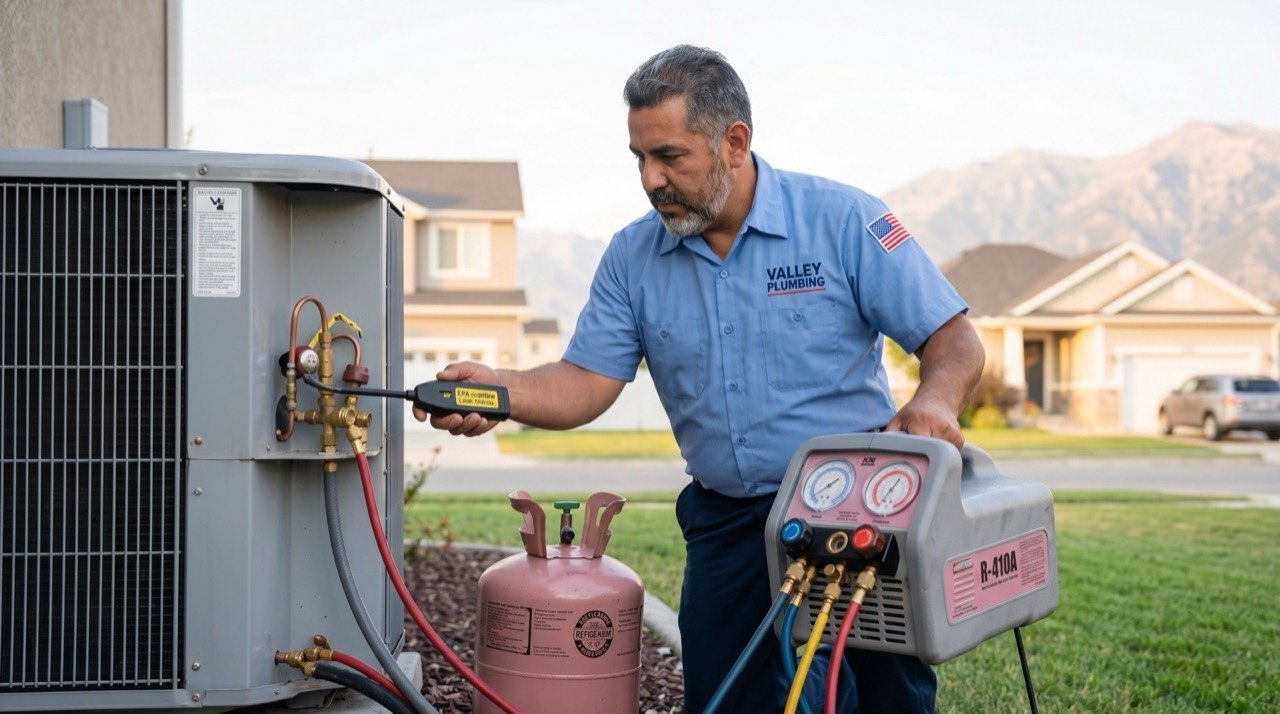
Tech connects manifold gauges, reads suction and liquid pressures, calculates subcooling and superheat. Confirms low-refrigerant fault and rules out other causes (dirty coil, failed metering device, restricted airflow).
Leak detection
For slow leaks, electronic leak detector (or UV dye if needed). For fast leaks, audible/oil-stain inspection usually locates it in 10 minutes. Tech shows you where the leak is before quoting the repair.
Repair the leak
Most leaks are at flare fittings or braze joints — we re-braze under nitrogen, tighten or replace flares. Bigger leaks (evaporator coil, condenser coil) get quoted on-site with honest repair-vs-replace math before we proceed.
Evacuate and recharge
Pull full vacuum to 500 microns, hold 30+ minutes to prove the seal. Weigh in factory-spec refrigerant charge by the pound — not guessed by gauge pressures. Check subcooling to confirm correct.
Verify cooling and log
Run system in full cool mode, measure temperature split across the coil (18–22°F target), confirm pressure readings match spec. EPA Section 608 documentation filed. Printed service report.
Pricing
Refrigerant Service Cost in West Jordan
Flat-rate pricing, quoted before any work. Leak search is separate from recharge — we always find the leak first.
AC diagnostic / service call
Low
$89
High
$129
Member
$76
– $110
Waived if you do the repair
Electronic leak detection
Low
$145
High
$285
Member
$123
– $242
Slow leaks, evaporator coil, flare fittings
UV dye leak detection (24–48 hr return)
Low
$175
High
$325
Member
$149
– $276
Very slow leaks requiring system runtime
R-410A recharge (per pound)
Low
$85
High
$135
Member
$72
– $115
Most 2010–2024 systems
R-32 recharge (per pound)
Low
$95
High
$145
Member
$81
– $123
New 2025+ systems
R-22 recharge (per pound — when available)
Low
$145
High
$225
Member
$123
– $191
Common on older eastside R-22 systems — replacement usually better value
Flare fitting repair
Low
$185
High
$345
Member
$157
– $293
Most common small leak
Line-set brazing repair
Low
$285
High
$575
Member
$242
– $489
Pinhole or joint leak in copper
Evaporator coil replacement
Low
$1,200
High
$2,200
Member
$1,020
– $1,870
When indoor coil is leaking — often time to replace system
Condenser coil replacement
Low
$1,450
High
$2,850
Member
$1,233
– $2,423
Outdoor coil leak — rarely worth fixing on old units
Member pricing reflects the Quality Service Club 15% repair discount. Service call fees are separate.
Pricing reflects 2026 residential West Jordan refrigerant work. EPA Section 608 certified technicians. R-22 availability limited — pricing varies by current market supply.
Quality Service Club
Skip the bill. Skip the line.
For $79 a year, members get 15% off every repair, priority dispatch on every call, and a free annual drain and plumbing inspection — the same stuff we'd charge $195 for on a cold call.
- 15% off repairs
- Priority dispatch
- Annual inspection
- 24/7 service access
- $25 referral bonus
- Parts + labor warranty
Plumbing
$79/year
- 15% off all plumbing repairs
- Priority dispatch — skip the line
- Annual drain piping inspection
- Full home water-supply inspection
- Tag on your emergency shut-off
- $25 referral bonus
HVAC (1 unit)
$199/year
- 15% off HVAC repairs
- Priority dispatch on furnace or AC calls
- Annual furnace + AC safety inspection
- Thermostat calibration and battery swap
- Outdoor condenser cleaning check
Plumbing + HVAC
$258/year
- Everything in both plans
- Whole-home annual inspection
- 15% off every service we offer
- Priority dispatch across plumbing and HVAC
Questions? Talk to a real human — (801) 341-4222
Cancel anytime. 1-year minimum.
Compare
R-22 vs. R-410A vs. R-32 — What's in Your System
Which refrigerant your AC uses determines repair economics. If you're on R-22, the math usually says replace.
| Feature | R-22 (Freon — phased out) | R-410A (Puron — current) | R-32 (new standard) |
|---|---|---|---|
| Years in systems | Pre-2010 installs, some through 2015 | 2010–2024 installs (most current systems) | 2025+ installs (new standard) |
| Production status | Banned from import/production since 2020 | Being phased out 2025–2030 | Primary refrigerant going forward |
| Recharge cost per pound | $145–$225 (if available) | $85–$135 | $95–$145 |
| Typical recharge (3-ton system) | $725–$1,125+ | $425–$675 | $475–$725 |
| Global warming potential (GWP) | 1,810 — high | 2,088 — high | 675 — much lower |
| Efficiency | Lowest — older systems | High | Slightly higher than R-410A |
| Best move if leaking | Replace the system — math rarely favors repair | Find and fix the leak, then recharge | Find and fix the leak, then recharge |
FAQ
Refrigerant FAQs in West Jordan
For R-410A, recharge runs $85–$135 per pound, and a typical 3-ton system holds 6–10 lbs depending on line length — so a full recharge is $425–$675 plus any leak repair. R-32 runs slightly higher per pound. R-22 recharge is $145–$225/lb when available and usually means it's time to replace the system instead.
We can, but we don't recommend it without finding the leak first. A system that's low on refrigerant has a leak — adding more refrigerant just means the leak happens again in 3–6 months, and you've paid for refrigerant twice. EPA rules also limit refrigerant handling without proper leak documentation. We prefer to find and fix the leak, then charge correctly.
Three options. One, recharge with R-22 at $145–$225/lb if we can source it — works short-term, doesn't fix the leak long-term. Two, retrofit to R-407C (similar pressures, works in most R-22 systems) — mid-tier solution. Three, replace the system — usually the honest answer on a 12–18 year old R-22 unit, especially common on the original-cohort installs in older eastside West Jordan subdivisions. We run the math with you before you decide.
Simple recharge with no leak repair is 45–90 minutes. Electronic leak detection adds 30–60 minutes. Flare or line-set braze repair adds 1–2 hours. Evaporator coil replacement is a half-day job. All of it quoted flat-rate before the work starts.
In order of frequency: loose flare fittings from years of compressor vibration, pinhole leaks in evaporator coil from formicary corrosion (common on 8–12 year old indoor coils, especially in newer Sugar Factory and Westridge homes), oxidized braze joints from poor original install, condenser coil damage from cottonwood-clogged fins or impact, and Schrader valve stem leaks (easy $100 fix).
R-410A and R-32 are non-toxic and non-flammable at normal concentrations, but they displace oxygen in enclosed spaces. Indoor leaks from a cracked evaporator coil should be handled quickly but aren't an emergency. R-32 is mildly flammable (A2L classification) — safe in normal AC volumes, but requires trained techs. We're fully certified for all three.
Yes — Jordan Landing restaurants, light commercial rooftops, walk-in coolers, and commercial split systems. Commercial work is priced separately from residential. We're EPA Section 608 certified (Universal), which covers all commercial refrigerant handling.
No, and it's illegal to try. EPA Section 608 requires certification for any refrigerant handling, and you can't legally buy R-410A, R-32, or R-22 without a 608 license. The DIY 'refrigerant recharge kits' sold online for car AC don't work on residential HVAC and can damage the system.
Formicary corrosion — tiny pinhole leaks that develop on copper coils exposed to indoor air chemistry (off-gassing from new construction, cleaners, pet urine). Common on 8–12 year old systems. Replacement runs $1,200–$2,200 for the coil itself. On older systems, a new matched system is often the smarter spend.
Annual tune-up (included in QSC HVAC membership) catches small leaks early via pressure check. Keeping the outdoor unit clear of cottonwood and debris reduces head pressure, which extends fitting life. Avoiding refrigerant 'top-offs' without leak repair is the biggest thing — patching without finding root cause almost guarantees the next leak.
Related services
Related West Jordan Cooling Services

AC Repair
Full-system diagnostics and flat-rate repair on every brand.

Evaporator Coil Service
Coil cleaning and replacement — the #1 source of slow refrigerant leaks.

AC Maintenance & Tune-Up
Annual pressure checks catch leaks early — included in QSC HVAC.

AC Installation
R-22 system time to replace? Load-calc'd install with R-32 or R-410A.

Emergency AC Repair
AC warm during a heatwave — 45–75 min dispatch from Dannon Way.
Available Around the Clock
Emergency?
We answer 24/7.
Burst pipe, no heat, AC down? Real plumbers pick up — no answering machines. Valley Plumbing serves Salt Lake City and surrounding areas any time, day or night.
Licensed & Insured — Utah Plumbing Contractor