Leak Detection
WATER LEAK DETECTION IN SALT LAKE CITY
Wet spot growing on a plaster ceiling. Sudden water bill spike. Sound of running water with everything off. We find hidden leaks in old SLC homes without tearing out lath-and-plaster on a guess.

4.8★ on Google
3,132+ reviews
24/7 Emergency
60–90 min dispatch
Licensed & insured
Utah plumbing contractor
5 Utah counties
50+ cities served
Flat-rate pricing
Quoted before we start
Overview
How we find leaks you can't see
A hidden water leak is the worst kind. By the time you can see it — wet plaster, sagging drywall, warped hardwood — the damage has been happening for days or weeks. The leak might be twenty feet away from where the stain shows up because water travels along framing before it drops. The wrong move is to start cutting walls open guessing where the source is. The right move is to find it first with non-invasive equipment, cut once, and fix it.
How leaks hide in old SLC homes
Old SLC homes have specific failure modes. Galvanized supply pinholes weep slowly behind plaster walls for months before staining anything. Cast iron drain joints crack and seep into framing. Bathroom waste lines — original lead bend pipes behind toilets — develop slow drips that rot subfloor. Slab leaks in Sugar House slab-on-grade homes show up as warm spots on the floor. Main supply line breaks in the parkstrip dump water under the foundation in Avenues homes built into hillsides. We see all of these every month.
What we use
- Thermal imaging camera — finds temperature differentials behind walls and ceilings. Hot water leaks show up bright. Cold water leaks show as cold zones. Non-invasive, no holes cut.
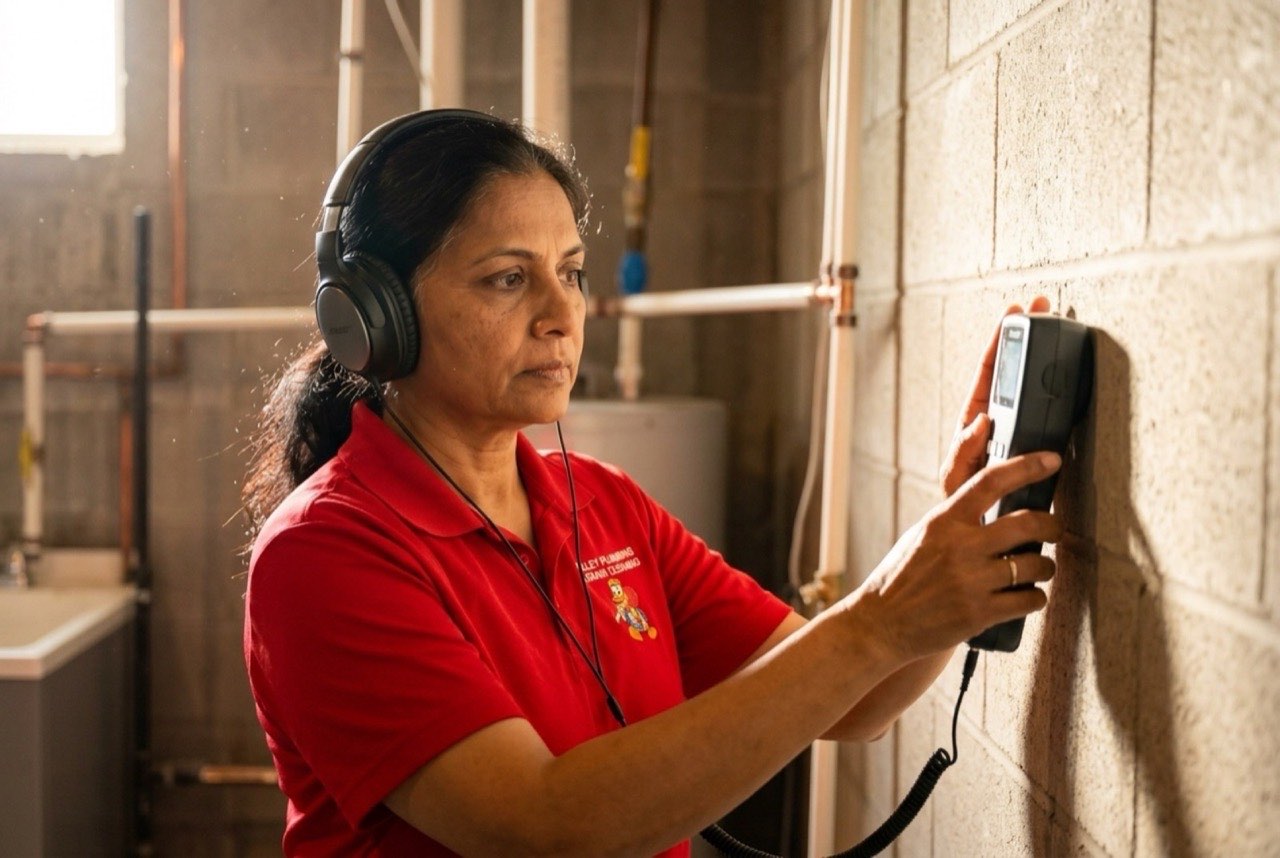
- Acoustic leak detector — pressurized line, sensitive microphone walks the wall to triangulate the leak's exact position. Best tool for slab leaks under concrete.
- Moisture meter — pin and pinless meters confirm what the thermal sees. Maps the wet zone so we know how far the water has spread.
- Pressure test isolation — shut off zones one by one to confirm which line is leaking. Critical when multiple suspect spots show.
- Tracer gas — for buried lines or extremely hidden leaks. Pump tracer gas into the line, sniff at the surface to find where it escapes.
What Valley does in SLC specifically
Our techs train on old SLC homes. They know that the leak in your Avenues bathroom ceiling is usually a copper line in the wall behind the upstairs sink, not the bathtub drain. They know that the wet spot in your Sugar House basement is usually a slab leak from the supply line, not the sewer. We narrow the suspect area before we cut, and we cut as small a hole as possible.
Detection is $295–$485. Detection fee is waived when we do the repair we found. Detailed leak map for your insurance adjuster if it's an insurable claim. Members of the Quality Service Club get 15% off detection plus the annual whole-home plumbing inspection that often catches slow leaks before they show stains.
Free quote
Schedule SLC leak detection
Tell us what you're seeing — wet spot, water bill spike, sound of running water. We narrow it before we cut.
4.8★
24/7
Emergency
Free
Quote
Current coupons
View allFREE
Detection fee waived with repair
Standard pricing. Repair must be approved during detection visit.
Expires 12/31/2026
FREE
Insurance documentation package
Included with any standard detection job.
Expires 12/31/2026
Mention coupon when booking. One offer per household.
Warning signs
Signs You Have a Hidden Leak in Your SLC Home
Some of these are subtle. Some you noticed three weeks ago. The longer they go, the more damage.
Wet or discolored spot growing on a plaster ceiling or wall
Higher water bill with no change in usage
Sound of running water when no fixtures are in use
Damp, musty smell from a basement, crawl space, or wall cavity
Warm spot on a slab floor (slab leak — common in Sugar House)
Hardwood floor cupping or buckling without obvious cause
Plaster bubbling or peeling on an interior wall
Moss, mold, or mildew on a wall that shouldn't be wet
Wet patch in the parkstrip or yard with no rain (main line leak)
Water meter spinning slowly with everything in the house off

Find it once
Stop guessing. Stop cutting drywall on hope.
Thermal and acoustic detection finds the source before we touch a wall. One small access cut, one targeted repair. Detection fee waived if we do the fix.
Versus 5 guess-cuts
1 cut
Across Salt Lake, Utah, Davis, Weber, and Tooele counties.
The Process
How Leak Detection Works in SLC
On the truck
Cable machine, jetter, and pipe camera — every call.
Walk the symptoms
Tech walks the visible damage and asks when it started, water bill history, and whether you've noticed sounds or smells. Old SLC homes have predictable failure spots — bathroom ceilings below upstairs baths, basement walls below kitchens, exterior walls with original galvanized.
Pressure isolation
Shut off zones one at a time and watch the meter. Confirms whether the leak is supply (pressurized) or drain (only when in use). Drain leaks are slower but harder to find — only show during use.
Thermal scan
Run the thermal camera across suspect walls, ceilings, and floors. Hot water leaks light up bright; cold water leaks show as cold zones. Slab leaks appear as warm spots on concrete in Sugar House and similar slab homes.
Acoustic and moisture confirmation
Acoustic detector triangulates the exact source. Moisture meter maps the wet zone. We mark the wall with chalk where to cut — usually a 12x12" access panel.
Quote and repair
Detection findings reported with photos. Repair quoted as a separate flat-rate. Detection fee waived if you have us do the repair. Insurance documentation included if applicable.
Pricing
Water Leak Detection Cost in Salt Lake City
Flat-rate detection. Repair quoted separately. Detection fee waived if we do the repair.
Standard leak detection (single area)
Low
$295
High
$485
Member
$251
– $412
Thermal + acoustic + moisture, one zone
Whole-house leak detection (multiple zones)
Low
$485
High
$750
Member
$412
– $638
Pressure isolation + thermal scan whole house
Slab leak detection only
Low
$295
High
$485
Member
$251
– $412
Common in Sugar House slab-on-grade homes
Main supply line leak (yard/parkstrip)
Low
$385
High
$685
Member
$327
– $582
Tracer gas + acoustic, locates underground
Repair after detection (varies)
Low
$295
High
$4,500
Member
$251
– $3,825
Quoted separately based on findings — often waives detection fee
Insurance documentation package
Low
Included
High
Included
Member
Included
– Included
Photos, location map, scope letter — included
Service call / dispatch
Low
$89
High
$129
Member
$76
– $110
Waived if we do detection or repair
Emergency after-hours surcharge
Low
$95
High
$150
Member
$81
– $128
Nights, weekends, holidays
Member pricing reflects the Quality Service Club 15% repair discount. Service call fees are separate.
Pricing reflects 2026 SLC residential work. Commercial leak detection (apartments, restaurants) quoted separately.
Quality Service Club
Skip the bill. Skip the line.
For $79 a year, members get 15% off every repair, priority dispatch on every call, and a free annual drain and plumbing inspection — the same stuff we'd charge $195 for on a cold call.
- 15% off repairs
- Priority dispatch
- Annual inspection
- 24/7 service access
- $25 referral bonus
- Parts + labor warranty
Plumbing
$79/year
- 15% off all plumbing repairs
- Priority dispatch — skip the line
- Annual drain piping inspection
- Full home water-supply inspection
- Tag on your emergency shut-off
- $25 referral bonus
HVAC (1 unit)
$199/year
- 15% off HVAC repairs
- Priority dispatch on furnace or AC calls
- Annual furnace + AC safety inspection
- Thermostat calibration and battery swap
- Outdoor condenser cleaning check
Plumbing + HVAC
$258/year
- Everything in both plans
- Whole-home annual inspection
- 15% off every service we offer
- Priority dispatch across plumbing and HVAC
Questions? Talk to a real human — (801) 341-4222
Cancel anytime. 1-year minimum.
FAQ
Leak Detection FAQs in Salt Lake City
Standard single-zone detection is $295–$485. Whole-house detection (multiple suspect zones) is $485–$750. Slab leak detection is $295–$485. Main line outdoor detection is $385–$685. Detection fee is waived when we do the repair we find.
Very. Thermal cameras pick up temperature differentials of a few degrees through plaster, drywall, or concrete. Acoustic detectors triangulate the leak source within a few inches. Combined, we typically find the source on the first pass and cut one access hole instead of five guesses.
Sudden accidental leaks (burst pipe, broken fitting) — usually yes, insurance covers the water damage but not the pipe repair itself. Slow leaks that have been happening for weeks or months — usually no, insurance considers those maintenance. Documentation matters either way. We provide a scope letter, photos, and a leak map for your adjuster.
A slab leak is a leak in a supply line buried in or under your concrete slab foundation. Common in Sugar House slab-on-grade homes from the 1950s–70s. Signs: warm spot on a floor, sound of running water with everything off, sudden water bill spike, foundation cracks, mildew smell. Thermal imaging finds slab leaks fast — heat radiates through concrete differently when there's a leak underneath.
Almost always, yes. Thermal and acoustic detection is non-invasive — we walk the wall with equipment, no holes. Once we've narrowed the source, we cut one small access hole (usually 12x12") to do the repair. Plaster patches more expensively than drywall, so accuracy matters.
Single-zone detection runs 60–90 minutes on-site. Whole-house detection is 2–3 hours. Slab leak detection is 60–120 minutes depending on house size. Repair time depends entirely on what we find — anywhere from a 30-minute fitting replacement to a multi-day repipe.
Rare, but it happens with extremely intermittent or low-flow leaks. If standard detection doesn't locate it, we add tracer gas testing or repressurization tests. If after all that we still can't find it (unusual), we charge only the standard detection fee — not for unsuccessful searches.
Yes — that's one of the strongest signs. Watch the water meter with everything in the house off. If the meter is moving, you have a continuous leak. Could be a running toilet (most common), a slab leak, or a buried main line break. We start with the cheap fixes (toilets) before we run detection equipment.
Yes. Some homeowners want detection only for insurance documentation or because they have a contractor for the repair. Detection-only is the same flat-rate price; we don't waive it without doing the repair. Full leak map and photos provided.
QSC ($79/year) gets you 15% off detection, priority dispatch when a leak is suspected, and an annual whole-home plumbing inspection that often catches slow leaks before they ever show stains on plaster.
Related services
Related Salt Lake City Plumbing Services

Slab Leak Repair
Detected a slab leak in Sugar House — repair, reroute, or repipe.

Burst Pipe Repair
Active leak with visible damage — fix and dry out same trip.

Repiping
Multiple leaks in old galvanized? Time for a full repipe.

Video Sewer Inspection
Drain side leak in cast iron? Camera finds the crack.

24/7 Emergency Plumber
Visible water actively spreading? Call now, don't wait.
Available Around the Clock
Emergency?
We answer 24/7.
Burst pipe, no heat, AC down? Real plumbers pick up — no answering machines. Valley Plumbing serves Salt Lake City and surrounding areas any time, day or night.
Licensed & Insured — Utah Plumbing Contractor