Whole house water filter maintenance starts with identifying the system you inherited, its purpose, and its service history.
Use this handover checklist to separate what you know from what needs confirmation before you buy parts or start work.
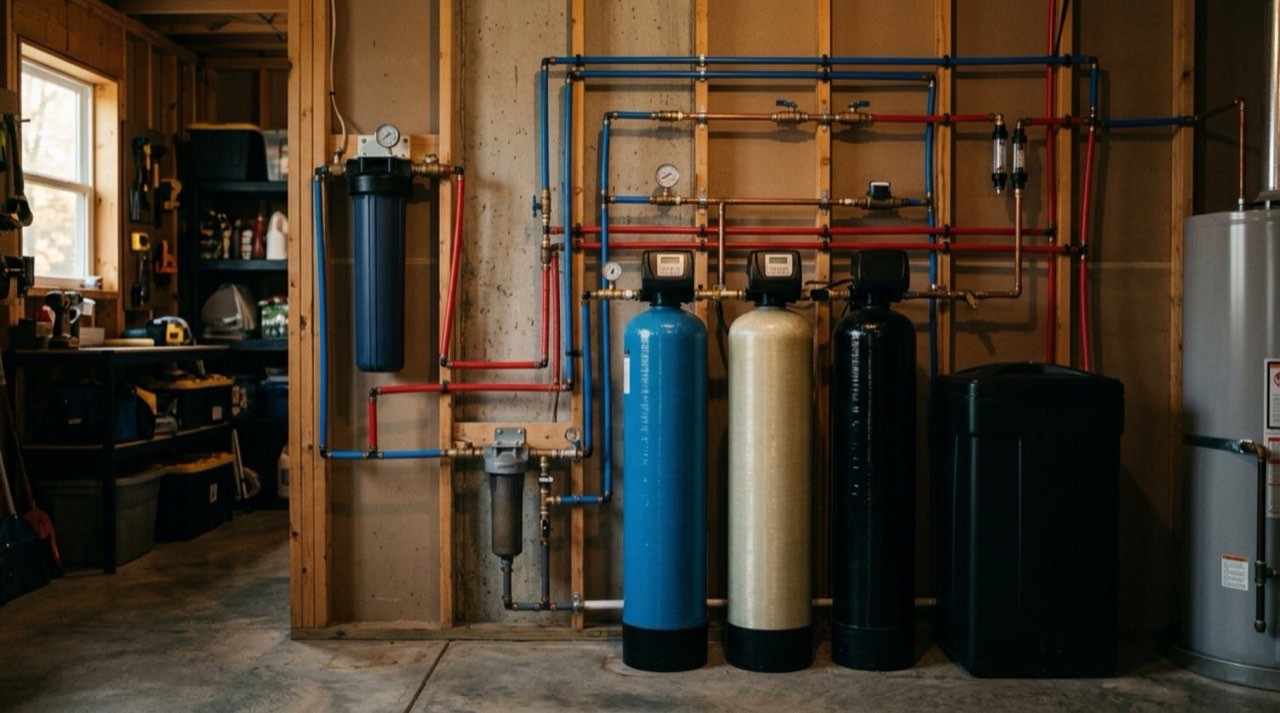
1. Create a record without opening the system
Begin with the home inspection report, seller's documents, and any service receipts left behind. Put copies in one folder rather than relying on scattered labels.
From a safely accessible position, photograph the system and visible labels. Capture the brand, model, serial number, and any setup or service stickers.
Do not loosen a filter housing to look for a cartridge number. An unfamiliar system needs a model check before any pressure-release or service procedure is attempted.
For a Lehi home with several tanks and housings, label your photos by location. “Large tank beside the water heater” is a useful starting description.
Give each unit its own entry. A nearby under-sink unit may have separate parts and service records from the system serving the rest of the home.
Write “unknown” wherever a label is missing or unreadable. That is more useful than assigning a model based on a similar picture online.
2. Recover the purpose as well as the model
Ask the seller or previous service provider what concern led to the setup. Request the relevant water report or test result if one exists.
The CDC guide to home water filters explains why a filter must match the substance or germ of concern. Not every system removes the same things.
A filter's presence does not confirm that your water needs that treatment. It also does not confirm that the current system still performs as intended.
For public water, find the water provider's current quality report. For a private well, collect existing test records and ask what current testing is right.
Do not judge drinking-water safety by taste, smell, or appearance alone. CDC notes that harmful germs and chemicals may not change those qualities.
A known model, a known treatment purpose, and a known service history are three separate facts. Finding one does not fill in the other two.
3. Match the manual to the installed system
Use the full model number to find the maker's directions. Check that the manual covers the exact product or clearly includes it in the listed series.
Keep the manual's title, revision date if provided, and download link with your photos. A retailer's general description is not a service procedure.
NSF's filter maintenance guidance explains that cartridges are not necessarily universal. Similar dimensions do not guarantee an effective replacement.
The same guidance notes that service cycles can be based on time or gallons. Use the actual product directions rather than a universal replacement calendar.
If the label and records do not match, contact Valley Plumbing about water filtration. Share the photos and ask for a check of the existing system.
Do not order parts solely because they resemble the old packaging left in a cabinet. Those parts may belong to another unit or an earlier setup.
4. Sort the handover into known, unknown, and next action
Use a simple three-part note for each unit. Keep the evidence beside the fact so you can see where it came from.
- Known: The exterior label gives a model number, and the maker's manual matches it.
- Unknown: There is no dated record of the last cartridge change or media service.
- Next action: Ask the service provider to confirm what is installed and what care is due.
Here is another example: an invoice lists a cartridge change, but it does not identify which housing received it. The date alone leaves a gap.
Ask the provider to connect that invoice to a specific unit. Do not assume every filter in the house was changed during the same visit.
For a Salt Lake City homeowner, the finished handover might have one checked item and two open ones. That is still a useful, honest record.
You can send that short list before an appointment. It helps explain whether you need a model check, a service plan, or investigation of an active problem.
5. Establish a new baseline with product-specific directions
An unknown service date is a reason to assess the system, not to guess how long the filter has left. Keep the uncertainty visible until resolved.
The maker's directions may include different tasks for different components. For example, the Hardless NG3 manual separates its cartridge, post-filter, and flush tasks.
Those directions apply to that product. They do not set the schedule for a tank or housing from another maker.
Ask which tasks you can perform using the actual manual and which require service. Do not add cleaning chemicals or attempt a flush on an unidentified system.
After work is completed, record the unit, date, installed part, and next needed action. Save the invoice and any updated directions together.
If a capacity-based limit applies, ask how usage is tracked. A reminder without a known starting point may not represent the product's remaining service life.
6. Keep active problems separate from missing paperwork
A missing manual is a record issue. Water leaking around the system, a damaged housing, or a sudden change in water service needs prompt attention.
Do not force an unfamiliar valve or loosen a connection while trying to identify it. Keep away from water near electrical equipment and request trained expert help.
If water quality is in question, ask the water provider or a qualified testing service for guidance. Do not assume a cartridge change resolves an unknown safety concern.
For help taking over an existing system in Lehi or Salt Lake City, request a water filtration check from Valley Plumbing.
Bring the photos, model numbers, existing water records, and the known/unknown list. The goal is a service plan tied to your system and supported by records.