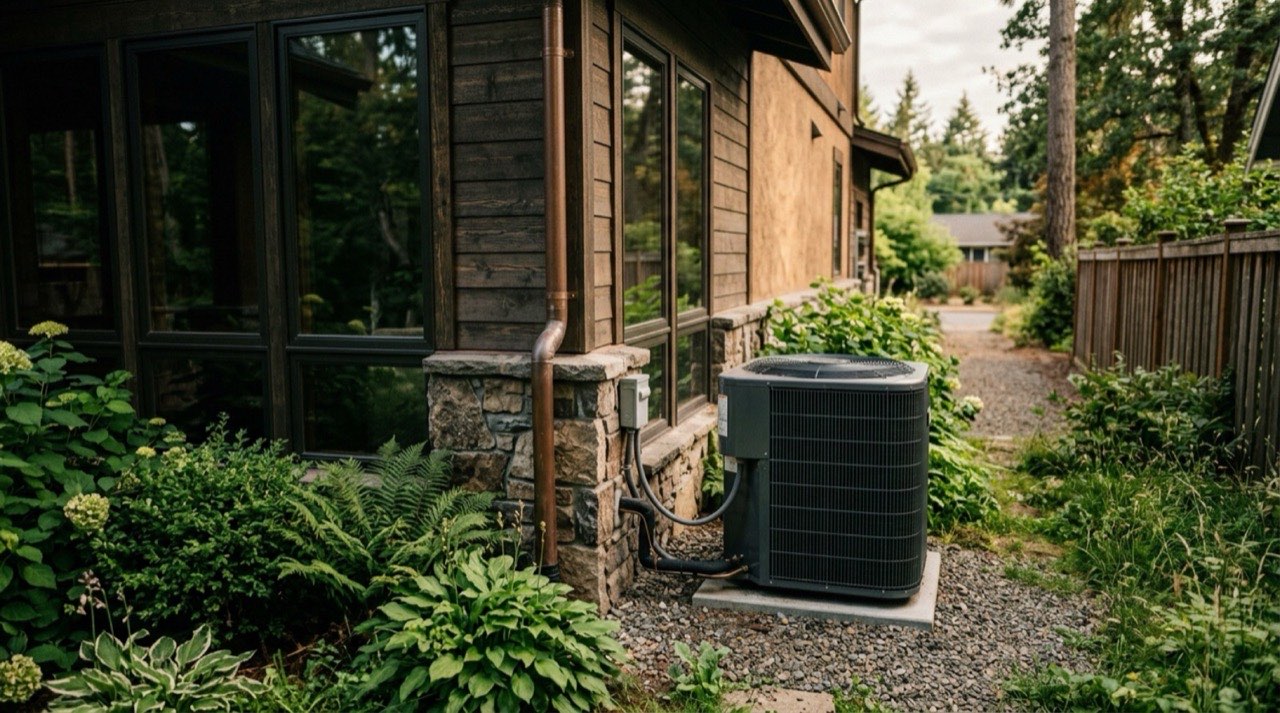
Weak airflow in one room calls for a room comparison before an equipment diagnosis.
Check whether that room's supply vent is open and clear, note what happens with the door open, and compare it with a room that cools normally.
Do not close other rooms' vents or alter hidden ducts to force more air into the problem space.
For a Salt Lake City homeowner, the key distinction is between a room receiving little air and a room receiving air but still feeling warm.
Confirm that weak airflow is limited to one room
Compare the problem room with another room while the system is operating normally.
Stand in ordinary occupied areas and note whether air movement at the supply vents seems different.
Keep fingers and objects out of the grilles.
Record which pattern you notice:
- One vent has weak airflow.
- Several vents in one room seem weak.
- More than one room is affected. You do not need to measure exact airflow to describe that pattern.
Also note when the difference began.
A room that has always been uncomfortable presents a different history from one that changed after furniture was moved or work was done nearby.
If airflow seems weak throughout the house, include that in your service request. The issue may need a broader investigation than a single room check.
Check the register and nearby furniture
Look for a rug, curtain, sofa or storage box blocking the supply vent.
Make sure its ordinary room-side adjustment is open if the vent is designed for homeowner adjustment.
Do not remove it or reach into the duct.
Find nearby return grilles too. Supply vents deliver conditioned air; returns provide a path back to the system.
The University of Florida's duct-system guide explains these paths and identifies furniture obstructions as a potential problem.
Move simple obstructions you can safely reach, then record what changed. Do not close vents elsewhere to redirect air.
Leave balancing decisions and hidden dampers to the technician.
If the vent is clear but the difference remains, request Valley Plumbing AC repair and describe the room pattern.
Compare an open door with a closed door
During ordinary use, note whether the room feels different when its door is open.
You do not need to latch doors repeatedly or leave the equipment running longer to perform a test.
Some homes have central return paths instead of a return grille in each room. A closed door can affect that path.
The University of Florida guide explains why supply and return airflow need to be considered together.
For example, imagine a Salt Lake City bedroom that becomes uncomfortable mainly when its door is closed overnight. That is a useful clue to report.
It does not prove that a new return grille, door cut or transfer vent is the correct solution.
Do not cut a door, wall or ceiling based on this observation. A professional needs to evaluate the actual airflow arrangement before recommending changes.
Separate airflow from room temperature
A room can feel warm even when you notice air at its vent.
Write down both observations: “Air feels weak” and “the room feels warmer” are not interchangeable.
Note whether the problem occurs all day or at a particular time. Include direct sun, a closed door or equipment that adds heat only as context.
These details do not establish that the AC is undersized.
For an accessible filter, follow the equipment instructions for inspection and replacement.
Carrier includes dirty filters and other airflow restrictions in its cooling troubleshooting guidance.
A filter condition should be reported alongside the room comparison, not used to explain every isolated symptom.
If the entire system develops ice or loses cooling, stop the room experiment and address that broader problem.
Leave duct changes to a professional
You may find online suggestions to open a duct, add a booster fan or move a damper. Those changes require understanding the system as a whole.
A visible symptom in one room is not enough information to choose one.
Do not climb into an attic or crawl space to follow the duct. Leave covers and insulation in place.
Tell the technician about any recent work in those areas, including work done for another purpose.
Ask what the inspection shows before agreeing that the room needs a particular modification.
Useful questions include whether the supply path is clear and whether return airflow is adequate.
The goal is a measured explanation for the room's condition. Your safe observations provide context; they do not replace airflow testing.
Bring a room comparison to the service visit
Prepare a short description naming the affected room, the comparison room, the door position and the time the problem is most noticeable.
Add whether airflow or comfort changed after moving a simple obstruction.
If you can sketch where the vents and doors are, bring that too. A rough drawing is enough.
There is no need to measure ducts or identify hidden equipment.
For weak airflow in one room of your Salt Lake City home, contact Valley Plumbing for AC service.
A focused room history helps the technician investigate the right area without assuming the whole system needs to change.