A water heater relief valve leaking through its discharge pipe needs prompt attention, even if you only see a drip.
Salt Lake City homeowners should keep the outlet clear and ask for qualified help instead of plugging it or assuming the valve simply needs replacement.
Leave the discharge path open.
Keep people away from the outlet, avoid contact with the water, and describe the discharge when asking for service.
Do not cap the pipe, operate the valve as a test, or remove parts.
If steam, flooding, or an electrical hazard makes the area unsafe, leave it.
Understand what the valve is doing
A temperature and pressure relief valve, often called a T&P valve, is a safety device.
Watts explains that it releases water when temperature or pressure reaches the valve's operating limit.
Discharge may indicate an unsafe condition requiring urgent attention from a qualified professional.
That does not mean every wet spot beside a heater comes from the relief valve.
A connection, drain valve, or another nearby source may be involved.
Describe what you can actually see without reaching around the heater or standing under an outlet.
If water is emerging from the open end of a pipe connected to the relief valve, report that location.
If you cannot find the pipe, say so.
A photograph taken from a safe, dry place can be more useful than an unclear component name.
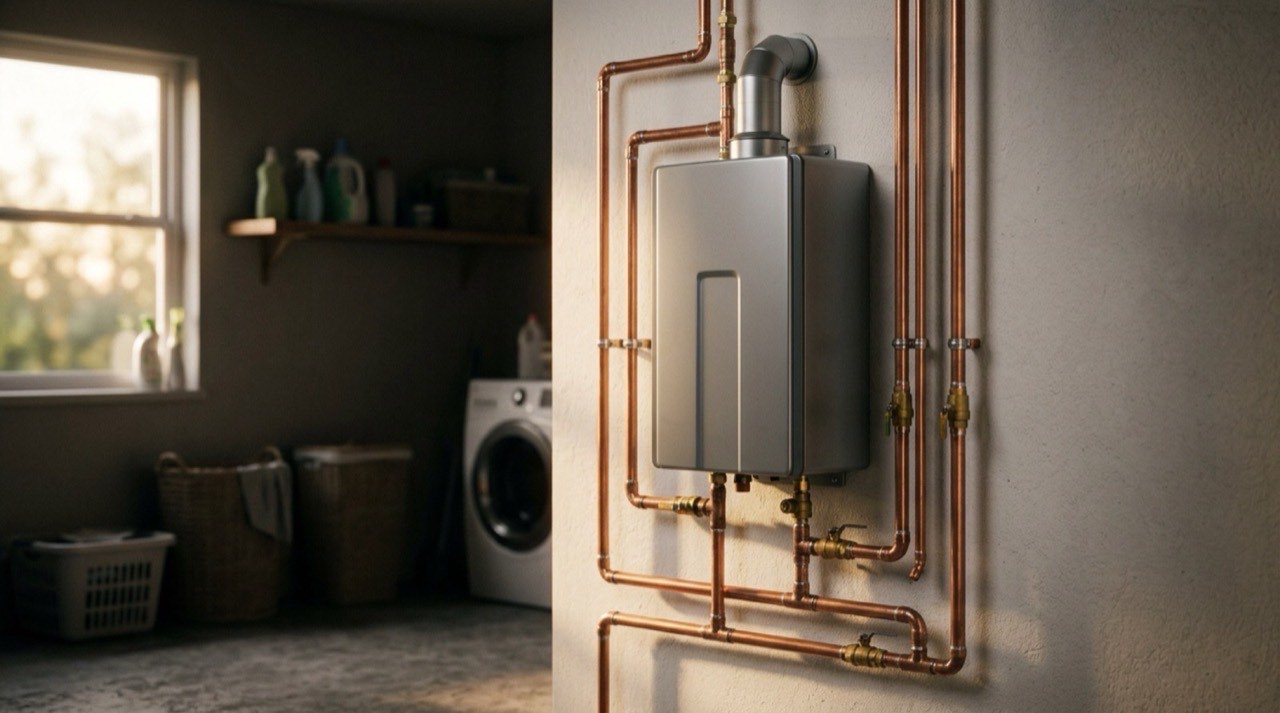
The image above is general water-heating imagery, not a guide to locating a T&P valve on your particular equipment.
Use the model documentation or professional guidance to find parts.
Do not turn a safety outlet into a sealed pipe
A drip can tempt someone to fit a cap over the pipe or attach a hose that blocks its end.
Do not do that. Watts' relief-valve safety guidance warns against plugging, capping, crimping, or restricting the discharge path.
Do not tie the valve lever in place, push something into the outlet, or try to stop the water with sealant.
The aim is to address the reason for the discharge while preserving the safety device's function.
Keep children and pets away. Treat discharged water as potentially scalding, even when the surrounding floor does not look hot.
Avoid reaching into a pan or container to judge temperature by touch.
Contact Valley Plumbing for water heater service and state that the relief discharge is active.
Mention steam, unusual sounds, or nearby electrical equipment when describing the situation.
Request guidance before approaching controls
Do not cross standing water or reach near a hot discharge to turn equipment off.
If a control is not clearly marked and safe to reach, leave it alone and ask for instructions from a qualified responder.
A heater's safe shutdown procedure depends on its model and energy source.
Follow the correct manual only when the steps are clear and you can safely reach the controls.
Do not open panels, adjust gas controls, or repeatedly reset equipment to see whether dripping stops.
If there is urgent danger to people, call emergency services from a safe location.
A service call should not delay leaving a room with steam, active electrical hazards, or rapidly spreading water.
These boundaries apply whether the leak seems small or large.
A small visible discharge does not show safe temperature or pressure inside the equipment.
Record the pattern without delaying help
If you can observe safely while help is being arranged, note a few specific details:
- Whether water comes from the pipe's open end or a nearby connection.
- Whether the discharge is intermittent or continues steadily.
- Whether it began after ordinary hot-water use or another known event.
- Whether there is visible water elsewhere around the heater.
- The heater model, if its label is easy to reach without approaching the hazard.
Do not run hot taps or start another heating cycle to recreate the problem.
You do not need a complete record before calling.
Report missing details honestly instead of waiting for a pattern to repeat.
A stopped drip still needs a check
For example, imagine that a homeowner notices water after an evening shower, then sees a dry pipe later.
That change is useful to report, but it does not show that the cause has been corrected.
Watts identifies thermal expansion, the increase in water volume as it heats, as one possible contributor to relief discharge.
Other causes may also need checking.
Replacing a valve without checking the system can miss the reason it opened.
Ask the plumber to explain the observed discharge, the checks needed, and what is needed before returning the heater to normal use.
Do not treat a quieter or drier moment as a reason to cancel the check.
Arrange the next step safely
For a leaking water heater relief valve in Salt Lake City, contact Valley Plumbing for water heater service.
Keep the discharge path open and share what you observed from a safe location.
The useful next step is a check of the valve and system, without a guessed diagnosis or a blocked outlet.