A tankless water heater low flow problem can show up as water turning cool during a small, steady draw.
For Salt Lake City homeowners, the useful first step is to describe when heating stops, rather than assume every weak stream means the heater needs replacement.
Keep the note simple.
Record the affected fixture, whether the tap stays open without stopping, and whether ordinary higher-flow use behaves differently.
Read any easy to reach display without opening the unit.
Do not defeat a faucet restriction, alter gas controls, or repeatedly change settings to force the heater to run.
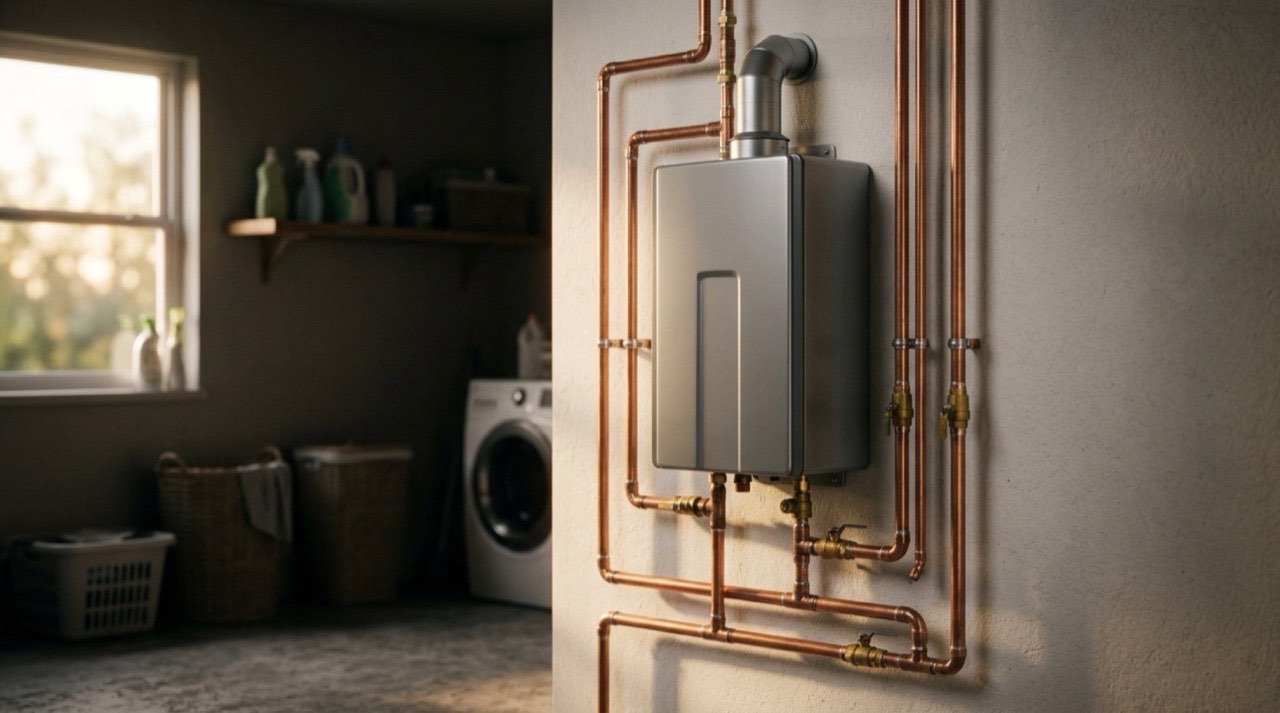
Separate weak flow from a heating dropout
“Low flow” can describe two different concerns.
Water may come out more slowly than expected, or it may flow normally for a small task but stop staying warm.
Tell the service provider which change you actually notice.
A tankless unit needs the right flow to heat water as it passes through.
The relevant flow requirements depend on the model.
Do not use a number from another maker's heater as a universal threshold for yours.
Rinnai's homeowner FAQ explains that low-flow fixtures and the hot-to-cold mixing ratio can affect activation.
Its guidance supports checking the exact model and fixture instructions.
It does not show that every cooling stream has the same cause.
A barely opened bathroom tap and a shower that suddenly lost pressure are different patterns.
Keep them separate in your notes, even if both involve the same heater.
Describe continuous use accurately
This guide concerns water turning cool while a tap remains open.
If the tap was turned off and then reopened, mention that instead.
An interruption between uses gives a different sequence for the plumber to assess.
During normal use, note whether the water warms first and then cools, never warms, or repeatedly changes temperature.
You do not need to repeat the event to produce a perfect record.
If the temperature changes unexpectedly while someone showers, stop that use rather than continuing to test it.
Do not ask a child or someone with limited sensitivity to judge the temperature. Report the change and arrange a check.
For ongoing heating dropouts, Valley Plumbing's water heater service is a relevant next step.
Explain that the concern occurs during a continuous small draw, rather than describing only “no hot water.”
Compare ordinary use without bypassing safeguards
Think back to another fixture used normally on the same day.
Did the kitchen tap remain warm while the bathroom tap cooled?
Did several outlets show the same behavior? Ordinary notes can narrow the discussion without creating a special test.
Do not open multiple taps simply to keep the heater active.
That may conceal the original pattern and leaves another outlet running.
Likewise, removing parts from a faucet or showerhead is not a safe shortcut to diagnosis.
If a fixture was recently changed, add that fact to the record.
A new showerhead, faucet, or mixing control may be relevant, but timing alone does not prove it caused the problem.
A plumber may need to assess the fixture and water supply as well as the heater.
Ask which part of the system the notes point toward before assuming the answer is a different heater size.
Check the model details and visible display
Read the model label only if it is easy to reach from a safe position.
Photograph it if that is easier than copying a long number.
Do not remove a cover or reach around hot piping to find it.
An external display may show a code or status when the water cools.
Record the exact text or number without repeatedly clearing it.
Note whether the display remained on and whether there was a recent power interruption.
Find the owner's manual for that exact model.
A similar product name is not enough to show the same settings or service procedures.
If you cannot find the model, tell the service provider and explain what you could not find.
Do not raise the temperature to compensate for a cooling stream.
Changes to heater settings affect other outlets and need model-specific guidance.
The goal here is to preserve a useful note, not experiment with hotter water.
Build a short description that helps diagnosis
Consider a hypothetical homeowner whose kitchen tap stays warm during washing, but whose bathroom tap cools during a small continuous draw.
The homeowner also remembers that the bathroom faucet was recently replaced.
A useful report includes all three details without naming a failed part.
It asks whether the new fixture and the heater's operating requirements need to be checked together.
Contrast that with a home where every hot outlet suddenly has weak flow, even when used normally.
That deserves a broader description.
Calling both situations a “low-flow setting problem” could hide the difference.
Know when to stop checking
Stop using the equipment and ask for prompt guidance if you notice a leak, repeated error indications, or uncontrolled temperature changes.
Keep away from wet electrical equipment.
For recurring tankless heating dropouts in Salt Lake City, contact Valley Plumbing for water heater service.
Share the model, affected fixtures, and sequence of temperature changes.
A focused description helps the next check without bypassing the controls intended to keep the system operating safely.