Black particles in filtered water may come from a new filter. But you cannot tell what they are by sight alone.
Stop using the affected water for drinking or food preparation while you check the exact model's instructions and seek advice.
Do not assume that every black speck is harmless carbon.
The useful first questions are simple: Which outlet has the particles? When did they first appear? What system and cartridge were installed?
These details help the filter maker or plumber choose the right steps. They are more useful than comparing your water with an unrelated photo online.
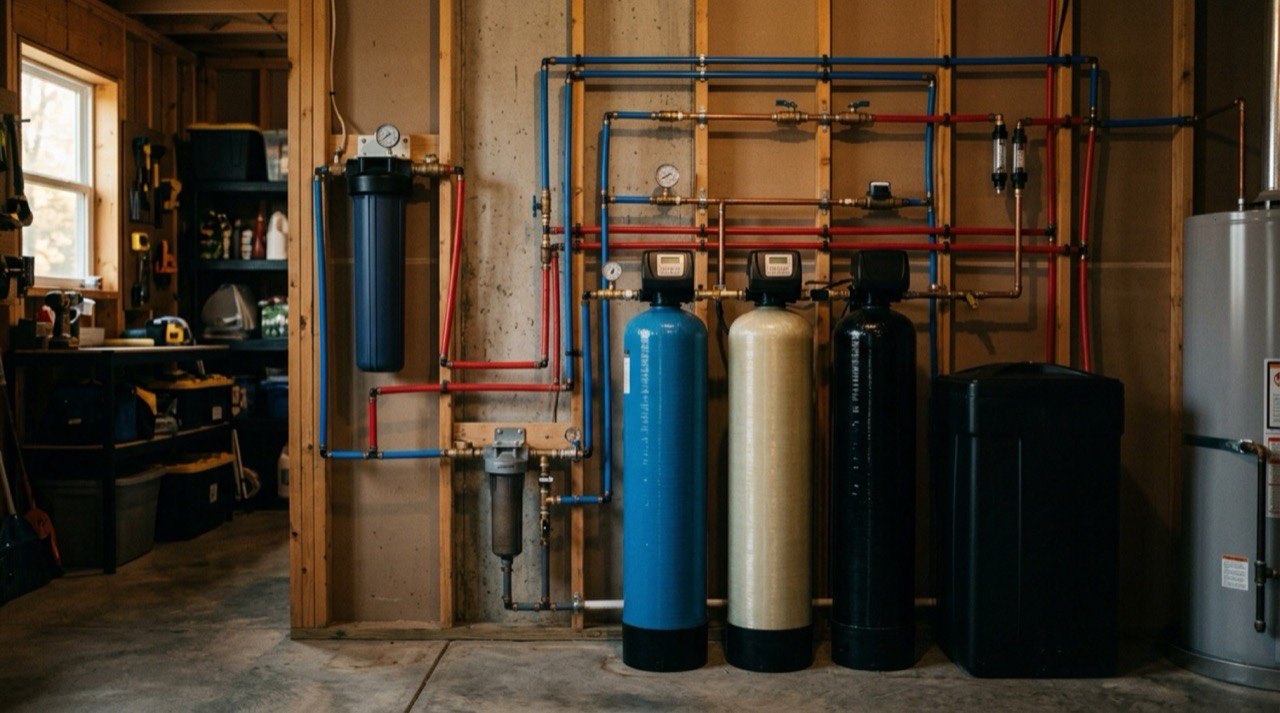
Why Carbon Is One Possibility, Not a Diagnosis
Some filters use carbon, and manufacturer instructions may address particles after a new cartridge is fitted.
For example, GE's refrigerator filter guidance discusses carbon particles and flushing for its equipment.
That guidance applies to the described product situation.
It does not identify material from an unknown whole-home filter, drinking faucet, or another appliance.
Even if your cartridge uses carbon, you still need to match the instructions to its exact model.
Avoid testing the particles by tasting the water, rubbing them on skin, or adding a chemical.
Keep the concern as an observation until the appropriate source helps identify it.
Make a Short Record Before Changing Anything
Write down the date and the first outlet where you noticed the particles.
Note whether the filter was changed that day or whether it had been in use for a while.
If you already have a clear photo, keep it with the record.
Save the cartridge packaging and the service receipt.
Look for the system model and replacement part number. NSF's replacement-filter guidance explains that filter cartridges are not universal.
The same size does not always mean the right part.
Do not remove the cartridge to read a hidden label. Use documents or an accessible exterior label.
If the information is missing, tell the manufacturer or service provider that the model is unknown.
Separate One Outlet From a Wider Pattern
Report where you have already observed the particles. Is it one filtered drinking faucet, one refrigerator dispenser, or several fixtures?
Do not run water throughout the home just to collect more examples. Use observations you can make safely during the initial check.
If only the newly serviced outlet is affected, the recent work is useful context. It still does not prove the cause.
If several outlets are affected, make that clear before anyone limits the assessment to one cartridge.
Also check for a current notice from your water provider. Follow its instructions if one applies.
The CDC's home-filter guidance explains that filters have different treatment roles.
Having a filter does not make every water concern safe to ignore.
Valley Plumbing's water filtration service can help arrange an assessment when particles persist or the source is unclear.
Share the outlet pattern and the exact part information you have.
Use Only the Correct Startup Instructions
A new cartridge may have a manufacturer-defined startup or flushing procedure. Find that instruction for the exact system before taking the next step.
Do not substitute a number of gallons or minutes from a different model.
If the correct manual permits an owner flushing step, follow it exactly. Do not continue indefinitely when the result does not match the instructions.
Contact the manufacturer or installer and explain what happened.
If the model is unknown, the instructions are unclear, or the procedure requires opening a housing, stop and seek help.
Do not loosen fittings or open a pressurized filter to look for the source of the specks. Do not take a risk to find a speck.
Know What a Clear Glass Cannot Prove
If the water looks clear after a documented startup step, that is an observation about appearance.
It does not prove every treatment claim or rule out things you cannot see.
Follow any remaining manufacturer or utility instructions before returning the system to normal use.
The same limit applies in reverse. Visible particles deserve attention, but their color alone does not tell you which repair is needed.
Wait for the equipment and source to be checked before naming the cause.
Ask the person helping you what result should be expected after the documented procedure and when to contact them again.
That creates a clear stopping point instead of repeated trial and error.
Bring the Timeline to the Service Conversation
An illustrative note might say: “Black specks appeared at the refrigerator dispenser after a cartridge change. We stopped drinking from that outlet.
We have the part package and need to confirm the model's startup procedure.” Another household might report particles at several fixtures with no recent filter work.
Those are different starting points.
For a Salt Lake City, Lehi, or Provo home, contact Valley Plumbing through its water filtration page.
Keep the outlet list, timing, and part information together.
They help guide the next step without treating an unknown particle as a confirmed diagnosis.