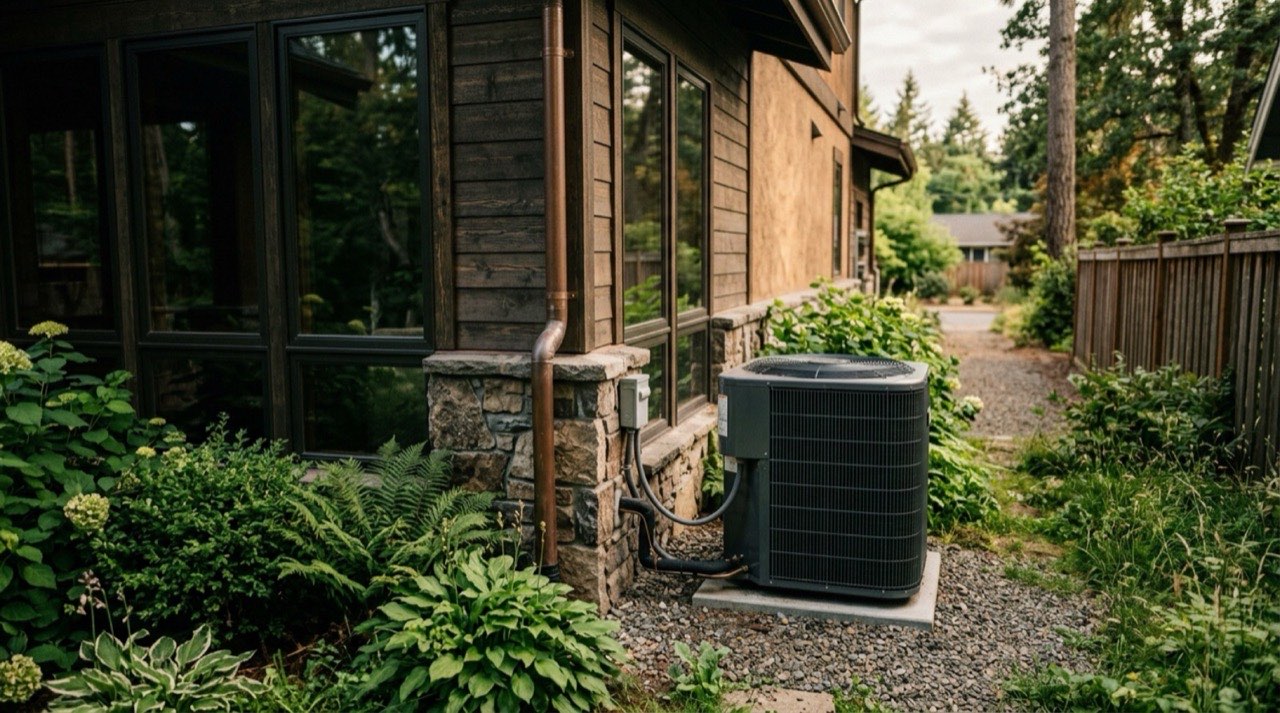
If your AC is not working after a power outage, check for an ongoing power problem and read the thermostat display.
Use the timeline below to separate a control delay from a problem that needs service.
Do not force repeated restarts. Stop for electrical warning signs, water near powered equipment or an outdoor unit humming with a still fan.
For a Salt Lake City homeowner, the key facts are what happened before power failed, after it returned and after anyone changed controls.
Check household power before the AC
Check whether the utility still reports an outage affecting your address.
Ordinary lights or appliances may give you context, but they do not prove that every part of the cooling system has power.
If lights are flickering or the home has another obvious electrical problem, avoid further AC tests. Contact the utility or an electrician about that condition.
Keep away from downed wires, wet equipment and damaged service lines. An active electrical danger takes priority over restoring cooling.
Write down whether the interruption was brief, prolonged or repeated. Use approximate times if that is all you know.
There is no need to invent an exact outage duration to request service.
Read the display and choose the right next step
Photograph the thermostat screen if safely accessible. Record the mode, target, room temperature and exact message before changing anything.
Match your next step to what is actually displayed:
- Delay message: Leave the settings alone and follow the waiting instructions for that model.
- Blank screen: Report it. Do not pull the thermostat off the wall or touch wiring.
- Cooling display with moving indoor air: Note both facts. They do not prove that the outdoor equipment is running or cooling has resumed.
Honeywell Home explains that applicable controls use a protective pause to prevent an early compressor restart. Its stated timing applies to those controls.
See Honeywell Home's equipment-delay guidance, then consult the instructions for your model.
If the stated delay has passed without normal operation, ask for service guidance. Do not extend the waiting period indefinitely or borrow another model's reset sequence.
Keep one restart within the equipment instructions
If the owner's manual provides a normal restart procedure and conditions are safe, follow that procedure exactly.
If you cannot identify the right instructions, ask for guidance instead of borrowing steps from a different system.
Do not turn controls off and on again and again because cooling has not resumed.
Avoid opening electrical panels, removing equipment covers or bypassing a safety control.
There is no universal sequence of breaker flips that applies to every air conditioner after an outage. A normal restart is one task.
Work on a damaged power supply is another.
If the manual's procedure does not restore ordinary operation, request Valley Plumbing AC repair.
Explain the steps you already followed so the next person does not have to guess.
Build a timeline that includes control changes
Use three entries. Approximate times are fine; write “unknown” where no one saw what happened.
- Before the interruption: Last known cooling, any earlier warm rooms or unusual sounds.
- When power returned: Utility status, screen message and indoor air movement before anyone changed a setting.
- After control changes: Who changed what, at which thermostat, and what happened next. Include any breaker reset already attempted.
Do not treat an earlier reset as unused just because a different household member performed it. Ask before anyone considers another attempt.
Here is an illustrative timeline, not a waiting-time recommendation:
- 3:00: Power returns; the screen displays a delay message.
- 3:04: Another person switches cooling off and back on.
- 3:08: The screen still displays a delay message.
That is not a clean record of eight minutes with untouched controls. The 3:04 change belongs in the report because restart timing may be affected.
Do not repeat the switch to prove this. Follow the model instructions using the real sequence, or ask for guidance if the sequence is unclear.
If power flickered again, add that as a separate event. Never fill a missing interval by assuming the AC was running throughout it.
Stop if a breaker trips or the unit hums
Do not keep resetting a breaker that trips.
If the outdoor unit hums but its fan does not move, turn cooling off at the thermostat when safe and leave the unit alone.
Carrier's AC fan troubleshooting guide describes several electrical or mechanical possibilities behind fan failure.
The cause needs a test.
Do not try to repair the capacitor yourself.
Do not push a fan blade with a stick or reach through the grille. Keep away from sparking, smoke and water near electrical equipment.
Call emergency services for an active fire or immediate danger.
If cooling still does not work, use another comfortable location while arranging help. Avoid extending an unsafe test because the house is getting warmer.
Give your technician the timeline, not a guessed cause
Share the outage and restoration times, whether power stayed steady afterward, the thermostat message and any normal restart steps you followed.
Include what the indoor fan and outdoor unit did.
If the AC was already struggling before the outage, mention that.
The timing matters.
A fault after an outage does not prove that the outage caused it.
For help restoring reliable cooling in Salt Lake City, contact Valley Plumbing for AC service.
A clear timeline helps the technician decide what to test without relying on repeated resets.