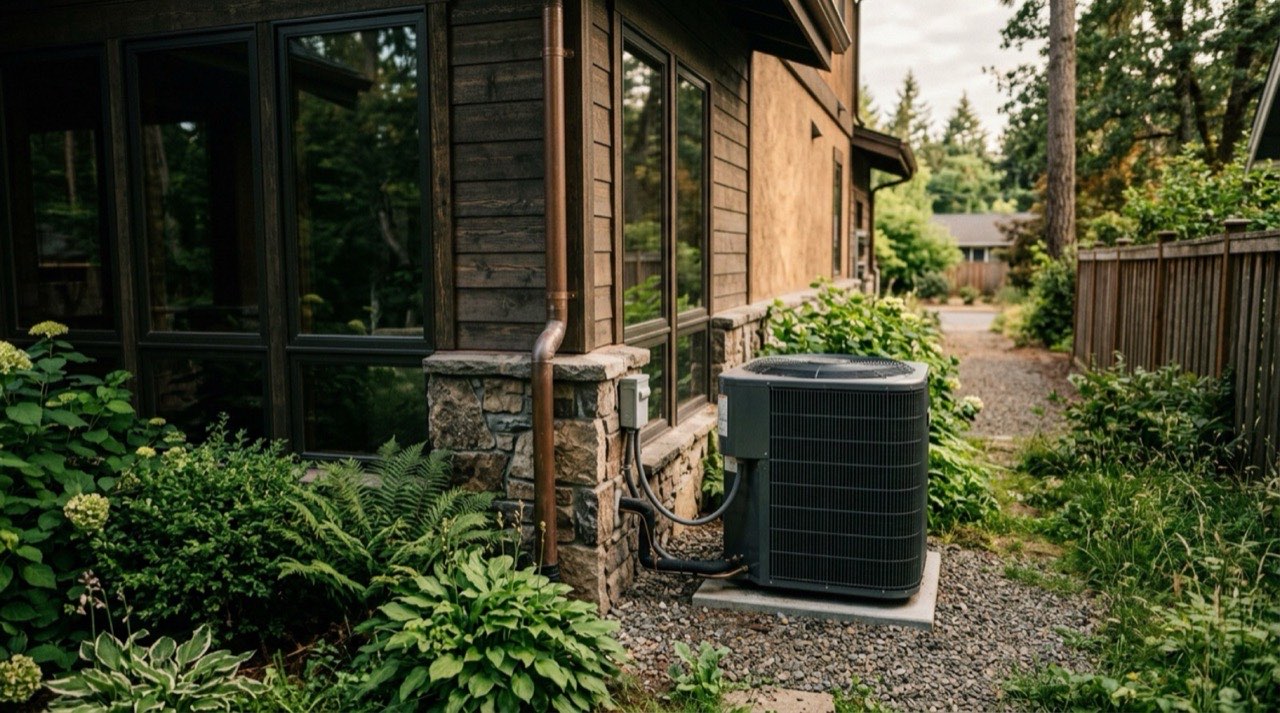
For an AC freezing up, turn cooling off at the thermostat and stop trying to run through the ice.
Do not chip it away or use a heater to melt it.
Note what you can see from a safe location, protect people from nearby water, and arrange service if the cause is unclear or the ice returns.
An icy pipe or coil does not mean the house is receiving extra cooling.
For Salt Lake City homeowners, it is a reason to pause operation and find out why the equipment is icing.
Stop cooling when you find ice
Leave covers in place and keep your hands away from coils, tubing and wiring. Avoid reaching into the outdoor fan area, even if the fan appears stopped.
The thermostat is the appropriate place to end the cooling call when it is safe to reach.
Trane explains that restricted airflow and refrigerant problems are among the possible causes of frozen coils. Ice alone does not tell you which one is present.
Its coil troubleshooting guidance also distinguishes homeowner observations from work requiring a technician.
Follow the equipment owner's instructions or the service provider's advice about the fan setting during thawing.
Do not assume a fan-only setting is appropriate if there is water near electrical equipment or another fault is present.
Record what you can see without opening equipment
A photo from safe ground can show where you first noticed the ice.
Take it before the ice disappears only if doing so does not delay a needed safety response.
Note whether the ice is on a visible refrigerant line, at the indoor equipment or somewhere you cannot identify.
“White ice on the exposed pipe beside the unit” is more useful than guessing the name of a hidden part.
Also record whether airflow seemed weaker before you saw ice. Did the house stop cooling first? Was the system running when you noticed the problem?
These details help explain the order of events.
Do not open a cabinet to improve the photo. A technician can inspect the parts you cannot safely see.
Check accessible airflow paths
Once cooling is off, check only the items the owner instructions allow you to access. Look at the filter's condition and confirm the specified size and type.
If it needs replacement, follow the manual; a different filter is not automatically a better choice.
Look for a rug, curtain or piece of furniture blocking a room vent or return grille. Leave duct adjustments and equipment panels alone.
Do not run the system with the filter removed as a test.
Carrier includes restricted airflow among the issues that can interfere with cooling.
Its AC troubleshooting guide supports checking simple airflow conditions before assuming a particular equipment failure.
If the filter and visible vents offer no clear explanation, that is useful information too.
You do not need to find a fault yourself before requesting Valley Plumbing AC repair.
Treat thawing as a pause, not proof of repair
Melting ice changes what you can see. It does not establish that the underlying problem has been corrected.
Water released during thawing also deserves attention, especially around the indoor equipment.
For example, suppose a Salt Lake City homeowner turns cooling off and later finds that the exposed pipe looks normal.
The useful report is “the ice disappeared after cooling was stopped.” It would be premature to report that the system is repaired.
Do not use a screwdriver, hair dryer, heat gun or hot water to speed the process. Let a technician advise when the system can be used again.
Keep children and pets away from the equipment and any wet area.
If water threatens a ceiling or reaches powered equipment, stay clear and describe that problem when seeking help.
Decide what needs a technician
Ask for service when ice returns, cooling remains poor or you cannot safely assess the visible conditions.
Mention an unusual sound, weak airflow or recent filter change without presenting it as the confirmed cause.
Refrigerant testing, leak diagnosis, internal coil inspection and electrical checks require the right training and tools.
Avoid advice that tells you to add refrigerant based only on a photo of frost.
Do not repeatedly restart cooling to see whether the ice comes back.
A repeat symptom is useful when it has already happened; there is no need to reproduce it for the service call.
While waiting, use another comfortable place if the house becomes too warm. Your comfort plan and the equipment diagnosis can be handled separately.
Prepare for an AC service visit
Write down:
- When you first saw ice and where it appeared.
- What the thermostat displayed.
- Whether cooling had changed beforehand. Include the filter information and any safely taken photo.
Keep a clear, dry path to the equipment if you can do so safely. Leave frozen or wet components untouched.
For an AC freezing problem in Salt Lake City, contact Valley Plumbing for AC service.
The next step is to identify the cause and confirm proper operation, rather than judge the repair by whether the ice has melted.