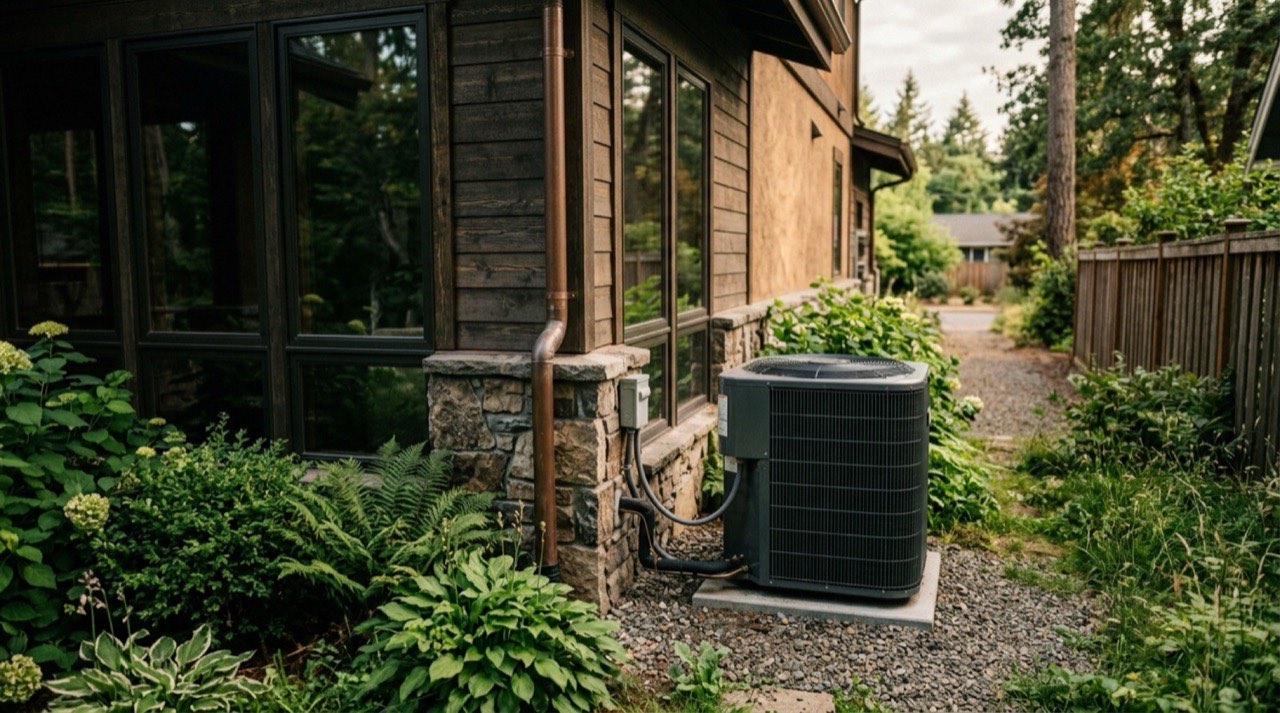
An AC fan not spinning while the outdoor unit hums is a reason to turn cooling off and arrange service.
Do not push the blades, remove a cover or keep restarting the system to see whether the fan catches.
You can give a useful report without identifying the failed part. Record what you noticed before shutdown, what happened afterward and what remains unknown.
For a Salt Lake City homeowner, that short record is more useful than trying to prove a diagnosis beside the outdoor unit.
Turn cooling off before collecting details
Set the thermostat's cooling mode to Off using the normal control. Do this before taking notes or looking for the equipment manual.
Do not stay beside the unit if there is smoke, sparking or a strong burning smell. Move away and seek emergency help for an active fire.
The outdoor fan moves air across the condenser coil so the system can release heat. Without that airflow, continued operation can overheat the compressor.
Carrier's AC fan guide explains this risk and identifies several possible electrical or mechanical causes.
Turning cooling off is a protective step. It does not establish that the equipment is electrically safe to touch or open.
Keep hands and tools outside the grille. Do not reach through it to clear a branch, test the blade or give it a push.
Keep indoor airflow separate from outdoor fan movement
The air coming from a room register and the fan visible outdoors are different observations. One does not prove that the other is working.
You may have noticed air moving indoors while the outdoor fan was still. Include both details when you describe the problem.
Do not select the thermostat's Fan On setting as a test of the outdoor fan. That setting concerns indoor air circulation.
If you have more than one thermostat or outdoor unit, identify the equipment only from labels or records you can read safely.
A useful note might say, "The upstairs thermostat was calling for cooling; I do not know which outdoor unit serves it."
Leave that connection unresolved if you cannot confirm it. Do not switch systems on and off to work out which unit makes the sound.
For a humming unit with a stationary fan, request Valley Plumbing AC repair and describe the stopped-fan condition first.
Know why a hum cannot identify the failed part
A capacitor, motor, control or power problem may prevent an outdoor fan from starting. The sound alone cannot separate those possibilities reliably.
A capacitor is an electrical component used by some motors for starting or running. Its appearance is not something you need to inspect.
Carrier warns that capacitors can retain a dangerous charge after power is off. Testing or replacing one belongs with a trained technician.
An online description of a similar noise is not a test result for your system. Different faults can look much the same from outside.
Likewise, a fan that briefly moved earlier does not show that the problem has cleared. Report that history without trying to repeat it.
There is no need to decide between a motor and a capacitor before requesting service. The symptom is enough to explain why cooling is off.
Leave a clear shutdown note for the household
Once cooling is off, tell anyone who uses the thermostat. A quiet outdoor unit afterward is not evidence that the fault cleared.
Use one shared note so the next person does not start a new test. Fill it from existing observations, not another cooling cycle:
- Observed by and time: Who saw the still fan or heard the hum? Use an approximate time if needed.
- Control used: Which thermostat was set to Off, by whom and when?
- Outdoor location: Describe the unit from a safe place, such as the one beside the garage.
- After shutdown: Sound stopped, sound continued or not checked.
- Unknowns: Unit pairing, earlier control changes or details no one saw.
- Next action: Cooling left off; service requested or still to be arranged.
Keep the note near the thermostat or share it with the household. Do not attach anything to outdoor equipment or block its controls.
If a sound continues, report it without approaching the cabinet or operating an outdoor disconnect to investigate.
Off at the thermostat does not make electrical parts safe.
Keep two observers and two units separate
Consider this illustrative example: one person hears a hum beside the garage and sees a still fan. Another person turns the upstairs thermostat off.
Later, the second person finds the yard quiet. They know which control they changed, but neither person knows which outdoor unit serves upstairs.
The useful report keeps those facts separate: “Still fan observed beside the garage. Upstairs cooling switched off. Outdoor unit pairing unknown.”
It does not say that switching the upstairs control fixed the garage-side unit. The timing alone cannot prove that connection.
If there are two systems, use existing labels or service records only when safely available.
Do not switch either system back on to match it to a unit.
Tell the service provider that the pairing is unclear and request guidance. If you cannot confirm the affected cooling call is off, say so promptly.
Keep earlier observations in the record even if someone describes the later scene differently. “Humming earlier, quiet after shutdown” is not a contradiction.
A thermostat photo may help explain the control state. Do not approach suspect equipment to obtain a sound recording or a better picture.
Keep the equipment untouched until it is checked
Leave cooling off while you arrange the next step. Do not run another cycle just because the home has become uncomfortable or the noise stopped.
If indoor conditions become unsafe, use a safer cool location while service is arranged. Keeping people comfortable should not depend on running suspect equipment.
Contact Valley Plumbing for AC service in Salt Lake City with your before-and-after record and the location of the affected equipment.
Share who changed the controls as well as who first saw the stopped fan.
The technician can then investigate without asking the household to repeat the fault.